

Learn English by surviving an island with AI friends
GameStudy • • 8 min read
Learning a language is painfully boring, and becoming fluent takes a long time. Duolingo made it easier to keep going with short lessons and streaks. But making practice easy is not the same as preparing someone to speak. A two-year streak can look like progress until you go blank trying to order at a restaurant.
GameStudy takes a different approach. It embeds language learning inside immersive games that give you something exciting to do and a real reason to speak.
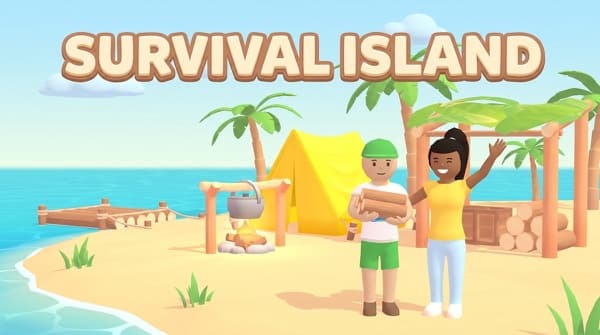
Survival Island is an adventure game inside GameStudy. You wake up shipwrecked on an island, complete 40 missions, and build what you need to escape. Along the way you rescue two AI friends named Kai and Ryan. You talk with them in real time as you play. They understand what is happening, respond freely, and take action inside the game. If you want their help, you have to speak to them.
TLDR
- Survival Island is an adventure game you play by talking. You are shipwrecked, and 40 missions stand between you and the raft that gets you off.
- The two other survivors on the island are AI. You rescue them, and then they play alongside you, gathering and building and fighting as a team.
- Asking them out loud is the only way to get their help. That is the whole design: English stops being the thing you study and becomes the thing you use to get something done.
- Beginners can play. The controls are deliberately simple, subtitles and translations are on screen, and one word is often enough.
- Diamonds you earn elsewhere in GameStudy turn into coins here, which buy items that help you progress.
What is Survival Island?
You wake up on a beach with no food, tools or shelter. Farther down the sand, a girl is sitting with her back to you. She has been alone for eleven days, counting each one on the rocks above the beach. You are the first person she has seen.
She turns and asks, “You’re okay? Are you hurt?”
Her name is Kai. After you rescue her, she joins you. Ryan is stranded on the far side of the island, and you cannot reach him until you build a bridge. When you finally get there, he looks at what you made and says, “Huh. So the bridge held. You’re the one who built it?”
Kai and Ryan are not tutors standing outside the adventure. They are castaways inside it. They understand the mission, notice what is happening, and work with you toward the same goal of leaving the island together.
How do you play Survival Island?
The controls are simple on purpose
Move your character with the joystick and walk up to something you want to interact with. Walk up to a tree and your character starts chopping. Walk up to a rock and your character starts mining. You do not have to learn complicated controls or constantly decide which button to press.
That simplicity is intentional. Speaking and understanding another language already take a lot of attention. We did not want difficult game mechanics competing for the same mental energy. The game handles the obvious actions for you so you can focus on the English conversation, the mission and your team.
Gather, build and survive as a team
You gather resources, process food, build structures, explore new areas and fight skeletons. Your hands hold only a fixed amount, so you need to store items, put them into a converter, contribute them to a structure, or hand them to a teammate.
Berries have to be processed into jars of jam before they restore energy. Energy is shared by you, Kai and Ryan. If it runs out, everyone moves and works more slowly, so keeping the group fed becomes a team responsibility.
There are 40 missions, including building a bridge, a tent, a rope table and a raft. You also cook jam, catch fish, harvest pumpkins, reach the summit and explore the cliff. The final mission is called “Leave the island.”
Use diamonds and coins to get useful items
Diamonds you earn elsewhere in GameStudy have value on the island too. You can turn them into coins, then spend those coins on items that help you progress. It connects what you do across the rest of GameStudy with your adventure here.
Speaking English means collaborating
Survival Island is not built around a fixed list of voice commands. You speak naturally as the situation changes. Kai and Ryan understand your words in the context of the current mission, your location, the resources everyone is carrying, and what is happening around you.
Here are a few examples of how you can collaborate. They are starting points, not the limits of what you can say.
| How you collaborate | What you might say |
|---|---|
| Get to know your teammates | “How are you?” or “How long were you here alone?” |
| Understand the goal | “What is the current mission?” or “What should we do next?” |
| Divide the work | “Can you get wood while I collect stone?” |
| Coordinate resources | “Bring me three planks” or “Put those berries in storage.” |
| Exchange items | “Here, take this” or “Can I have what you’re carrying?” |
| Move together | “Follow me,” “Wait here,” or “Take me to the bridge.” |
| Reach a place quickly | “Teleport me to the storage area.” |
| Solve a problem | “How do we build this?” or “What does this machine do?” |
| Ask for support | “I’m stuck. Can you help me?” |
One moment you might ask Kai to gather wood. The next, you might ask Ryan where to go, tell both friends what you plan to build, or ask what an unfamiliar object is called. You can even coordinate between them by saying, “Ryan has the wood. Can you take it from him?”
There is far more you can discuss than any table could capture. As the island changes, the conversation changes with it. English becomes how you think out loud, solve problems and move the adventure forward together.
AI friends who understand the game
Kai and Ryan respond while you play, not in a separate scripted lesson. They react when a mission ends, a skeleton appears, someone is knocked down, you unlock a tool, the group runs out of energy, or a storm begins.
They also understand the game well enough to help when you are confused. Ask “What is the current mission?”, “How do I play?” or “What should I do next?” and they explain the goal in their own words. If you do not know where to go, they can guide you there, or teleport you straight to another location.
They answer before taking action, so you know whether they understood. If they cannot do something, they explain why instead of failing silently. They can also ask you for things, which makes the whole thing feel like teamwork rather than operating two game characters.
Learn words from everything around you
The island is full of objects, materials, tools, food, animals, structures, locations and actions. Each one creates a natural opportunity to learn English.
You do not study “berries” as an isolated word. You see berries hanging on a bush, shake the bush until they fall, pick them up, and turn them into a jar of berry jam. You learn words like wood, stone, rope, planks, bridge, storage, berries and fish while using them to solve a problem.
You can also ask Kai and Ryan what something is called, what it does, or how to use it. The island becomes a living visual dictionary, with every word connected to something you can see and do.
Can beginners play?
Yes. Kai and Ryan speak in short bursts and then wait. Every line appears on screen as they say it, with a translation underneath that you can turn off when you no longer need it.
You can revisit missed lines in the conversation history, tap any word to see its meaning, save useful vocabulary, slow down the speech, or ask for a hint. Kai and Ryan also understand your own language, so getting stuck does not end the conversation.
You do not need a perfect sentence. Often one word is enough. Say “wood,” and your teammate can take it from there.
Why can learning inside a game be effective?
In Survival Island, English is connected to something you want to accomplish. You need rope to build. You need food to restore energy. You need your teammates to help finish the mission. That gives every word an immediate meaning and purpose.
A systematic review of seventy-eight studies on involvement load found that vocabulary tasks demanding more from the learner tended to produce better incidental vocabulary learning. Research on the production effect also shows that producing information, such as saying a word aloud, can improve memory compared with reading silently.
A meta-analysis of multimedia vocabulary glosses found benefits from combining words with pictures and audio. And a study of sixty learners at one institute found that using games increased their willingness to communicate.
Survival Island brings those principles together. You see the object, hear the word, say it aloud, and use it to accomplish something with another person. Corrections happen naturally inside the conversation, and you can review the written feedback after you play.
It is not a complete grammar course. It is designed to build practical vocabulary, listening, speaking, and the confidence to use what you know.
A survival camp you can enter from home
An immersion trip gives language a place, a purpose and people to speak with. A survival camp adds teamwork, unfamiliar surroundings and real problems to solve. Survival Island brings those ingredients together in one experience you can reach from anywhere, at any time.
With a GameStudy subscription you can return to the island as many times as you want. There is no plane ticket to buy, no camp reservation to make, no travel schedule to arrange. Whenever you want to practice, the island and your two AI friends are ready.
Every visit is another chance to explore an English-speaking world, learn the names of everything around you, and practice real conversation while working toward a shared goal.
Build the bridge. Rescue Ryan. Keep everyone fed. Finish the raft. Escape together.
Download GameStudy and start speaking your way off the island.